Showing posts with label history. Show all posts

Saturday, November 4, 2023

Night of the Witch

 Night of the Witch
Sarah Raasch, Beth Revis
416 pages
Sourcebooks Fire


From Goodreads: Fritzi is a witch. A survivor of a brutal attack on her coven, she's determined to find her only surviving family member and bring the hexenjägers—zealot witch hunters—to justice for the lives they ended. To do this, she will need to take down their leader—Kommandant Dieter Kirch.

Otto is a hexenjäger and a captain, the second in command to Dieter Kirch—but that's just his cover. Years ago, the hexenjagers burned his innocent mother alive and since then, he has been planning a move against the witch hunters that tore his family apart. And now the time has come for them to pay for what they've done.

When Fritzi and Otto are unexpectedly thrown together, neither is sure they can trust the other, despite their common enemy. But all they have is one another, and they both crave revenge. As truths come to light and trust shifts, Fritzi and Otto uncover a far more horrifying plot at the center of the hexenjäger attacks . . . but their own growing feelings for each other may be the most powerful magic of all.

Allow me to digress for a moment. While I was reading this book I celebrated my 37th birthday. When I got into modern YA sphere I was in my early twenties and I eagerly fed on every new YA I could get my hands on. I religiously followed my library's RSS feed for new titles and was frequently first on the waitlist and the first year I read over 250 books. I literally gobbled, eye gobbled, books/series such as Beautiful Creatures, Hush Hush, Anna and the French Kiss, Hourglass, Dearly Departed, Wither, Die for Me... I could go on for ages but the point is each seemed better than last and I couldn't get enough. Things are different now. I'm 15 years older and I've seen YA publishing trends come and go, and while I still believe YA knows to no age limit, I can't help but wonder if I've reached a point where I should take a break, but I can see through my 2022/23 reading lists that I've organically moved towards more non-fiction, adult fiction, and thrillers. The last YA I read before this was Fourth Wing, which I adored, but the few others I've read this year have been underwhelming. I could wax on this for a long time, so I'll get on with it now. I guess what I mean to say is take my YA reviews with a grain of salt for the moment.

The title and stunning book cover drew me to this book on NetGalley. The bright neon green on top of a geode-looking swirl with runes is just beautiful. The description promised a forbidden romance with danger and adventure. Sign me up! And indeed there was action and adventure from the start of the book, barely ceasing. This is a great tradition in YA literature and certainly kept me turning Kindle pages until I literally fell asleep. Fritzi is on the run the entire novel and Otto is her unlikely companion. 

Speaking of Otto, his backstory is revealed slowly throughout the book and he's not what he seems. His relationship with Fritzi is cute, but suffers from a bit of "insta-love." I struggled with believing their bond was serious because it felt so unrealistic. But still, they had their moments and it's not like I didn't want them to get together.  At over 400 pages I would have expected better character development, but that would have slowed down the aforementioned fast pace I just praised. You can't have it all! 

One aspect of the book I enjoyed was the Germanic influence because it's not something I've come across before. Many fantasy books seem to have a generic far-east influence or something vaguely British. In the authors' afterward, I discovered that the book is based on actual witch trials that later inspired the Salem Witch Trials. This surprised me and is something I now have to find some nonfiction about. The Black Forest particularly appealed to me, so I'll be looking into that as well since my current knowledge is limited to ham and cuckoo clocks. My German ancestors are rolling their eyes at me right now.

I gave the book three stars because, while fast and fun, I felt like something of substance was missing. Again, take that with a grain of salt since YA and I apparently have a complicated relationship right now. If you love fantasy witchcraft books I think you'll enjoy this. Thanks to NetGalley and the publisher for the early copy. Opinions are my own.

Friday, April 28, 2023

Riding Jane Crow: African American Women on the American Railroad by Miriam Thaggert

Riding Jane Crow: African American Women on the American Railroad
Miriam Thaggert
208 pages
University of Illinois Press


From Goodreads: Miriam Thaggert illuminates the stories of African American women as passengers and as workers on the nineteenth- and early-twentieth-century railroad. As Jim Crow laws became more prevalent and forced Black Americans to "ride Jim Crow" on the rails, the train compartment became a contested space of leisure and work. Riding Jane Crow examines four instances of Black female railroad the travel narratives of Black female intellectuals such as Anna Julia Cooper and Mary Church Terrell; Black middle-class women who sued to ride in first class "ladies’ cars"; Black women railroad food vendors; and Black maids on Pullman trains. Thaggert argues that the railroad represented a technological advancement that was entwined with African American attempts to secure social progress. Black women's experiences on or near the railroad illustrate how American technological progress has often meant their ejection or displacement; thus, it is the Black woman who most fully measures the success of American freedom and privilege, or "progress," through her travel experiences.

My local library came through for me again, specifically ordering a university press book that piqued my interest. How much did I know about Black women and the railroad? Admittedly, not much beyond the Great Migration, and for some reason the cover really captured my attention as well as the feminized version of Jim Crow in the title. 

There was much to uncover that I had never considered before. For example, the porters on the Pullman trains are ubiquitous but how have I gone this long not knowing about the Black maids! Their stories and accompanying photographs were fascinating, as was the introduction to activist Pauli Murray later on in the book, who introduced the phrase "Jane Crow" used in the title.

As with any good history book, something specific caught my attention and left me wanting more. Thaggert mentions work by Psyche A. Williams-Forson when writing about the food vendors who sold quick meals to travelers through train windows. These women were a major part of the local economy, purchasing vast amounts of chicken, flour, and other ingredients to cook and sell. Thaggert cites Williams-Forson when discussing how women were able to purchase homes with their profits, and so now I have the books Building Houses Out of Chicken Legs and Eating While Black on my shelves waiting for their turn to be read.

I think any reader with an interest in Black history will find this book useful, especially those who like to study the intersectionality between race and gender. The book is meticulously researched and noted and I highly recommend it.

Sunday, March 26, 2023

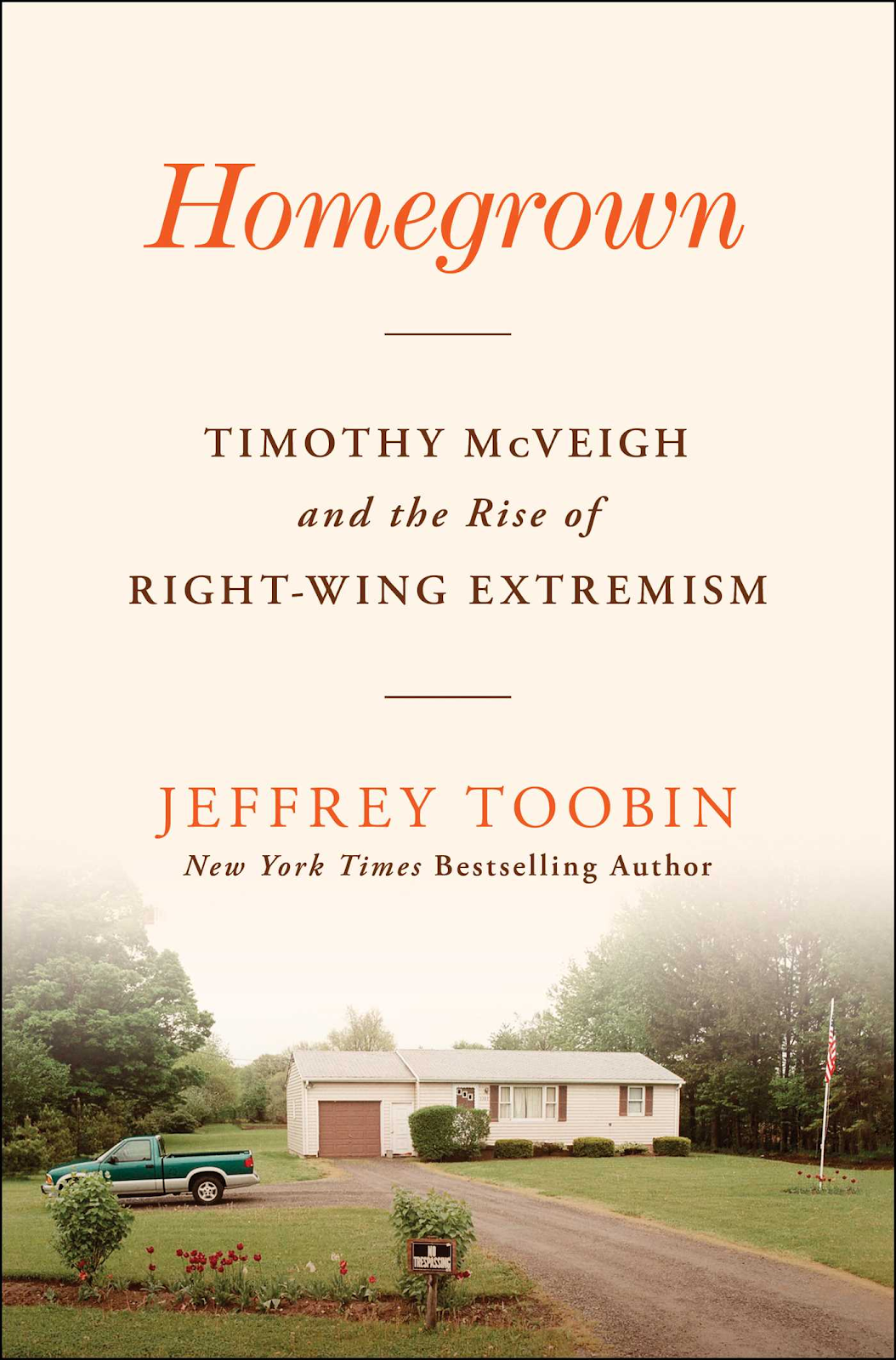
Homegrown by Jeffrey Toobin

Homegrown: Timothy McVeigh and the Rise of Right-Wing Extremism 
Jeffrey Toobin
432 pages
Simon Schuster 


From Goodreads: Timothy McVeigh wanted to start a movement.

Speaking to his lawyers days after the Oklahoma City bombing, the Gulf War veteran expressed no regrets: killing 168 people was his patriotic duty. He cited the Declaration of Independence from memory: “Whenever any Form of Government becomes destructive of these ends, it is the Right of the People to alter or to abolish it.” He had obsessively followed the siege of Waco and seethed at the imposition of President Bill Clinton’s assault weapons ban. A self-proclaimed white separatist, he abhorred immigration and wanted women to return to traditional roles. As he watched the industrial decline of his native Buffalo, McVeigh longed for when America was great.

New York Times bestselling author Jeffrey Toobin traces the dramatic history and profound legacy of Timothy McVeigh, who once declared, “I believe there is an army out there, ready to rise up, even though I never found it.” But that doesn’t mean his army wasn’t there. With news-breaking reportage, Toobin details how McVeigh’s principles and tactics have flourished in the decades since his death in 2001, reaching an apotheosis on January 6 when hundreds of rioters stormed the Capitol. Based on nearly a million previously unreleased tapes, photographs, and documents, including detailed communications between McVeigh and his lawyers, as well as interviews with such key figures as Bill Clinton, Homegrown reveals how the story of Timothy McVeigh and the Oklahoma City bombing is not only a powerful retelling of one of the great outrages of our time, but a warning for our future.

I was a kid when the Oklahoma City Bombing took place, but combined with other simultaneous big news stories, it's probably one of the first ones I can recall hearing about - we watched Dan Rather every night during dinner when I was growing up. Scrolling through NetGalley I came across this book and my interest was piqued.

In some ways, I think, McVeigh was ahead of his time. The author continually states that McVeigh couldn't find his people, his army with the same beliefs as him, but as we've seen with the explosion of the internet that army is well formulated today. When McVeigh was arrested during a traffic stop after the bombing it was for his gun. That law is no longer in existence and the trooper would have let McVeigh go if it was today. Even scarier, McVeigh's extreme beliefs in 1995 are far from extreme in 2023. Absolutely if he would have been caught today he would still be found guilty, but I think he would have a lot more public sympathy and it's possible he would avoid the death penalty as a result.

The comparison between Merrick Garland's response and Bill Clinton's was fascinating and I can't help to think what might have been different if Garland had played up the right-wing discontent during the trial. Would domestic terrorism be more on the forefront of people's minds heading into 9/11? The blip about the FBI's domestic terrorism report during the Obama administration was also worth pondering.

The author spends a lot of time comparing the OKC bombing and January 6th. It's an apt comparison and I don't dispute it, but it comes up so much that it gets a little tired. Overall, though, the book is well-written and presented in an easy to understand chronology. The beginning of the book about McVeigh's youth dragged a bit, but things (obviously) picked up when he started collecting parts for his bomb. I had to put the book down for a bit as the bombing was described; it was gripping and tough. The second half of the book following McVeigh's trial was extremely interesting. I do wish a little more had been explained about Nichol's trial.

This is a great read for true crime fans and those who know of the OKC bombing but not much behind it. I learned a lot and thank you to the publisher and NetGalley for an advanced copy of this book. As always, opinions are my own.


Tuesday, February 21, 2023

Africatown by Nick Tabor

Africatown: America's Last Slave Ship and the Community It Created
Nick Tabor
384 pages
St. Martin's Press


From Goodreads: An evocative and epic story, Nick Tabor's Africatown charts the fraught history of America from those who were brought here as slaves but nevertheless established a home for themselves and their descendants, a community which often thrived despite persistent racism and environmental pollution.

In 1860, a ship called the Clotilda was smuggled through the Alabama Gulf Coast, carrying the last group of enslaved people ever brought to the U.S. from West Africa. Five years later, the shipmates were emancipated, but they had no way of getting back home. Instead they created their own community outside the city of Mobile, where they spoke Yoruba and appointed their own leaders, a story chronicled in Zora Neale Hurston’s Barracoon.

That community, Africatown, has endured to the present day, and many of the community residents are the shipmates’ direct descendants. After many decades of neglect and a Jim Crow legal system that targeted the area for industrialization, the community is struggling to survive. Many community members believe the pollution from the heavy industry surrounding their homes has caused a cancer epidemic among residents, and companies are eyeing even more land for development.

At the same time, after the discovery of the remains of the Clotilda in the riverbed nearby, a renewed effort is underway to create a living memorial to the community and the lives of the slaves who founded it.

The Clotilda is having a bit of a moment, I think (and rightly so). Last year Ben Raines released his book The Last Slave Ship: The True Story of How the Clotilda Was Found, her Descendants, and an Extraordinary Reckoning, which became an NPR Best Book of 2022. In 2018 Zora Neale Hurston's work Baracoon: The Story of the Last "Black Cargo" was rereleased and this is where I picked up my research of the Clotilda in 2019. Previously, I had only read a few of the news articles that surfaced around the time the ship was found and reading the short Baracoon left me needing more... a lot more.

And here we have Africatown, the latest tome about the Clotilda to be published. For roughly the first half of the book, the author focuses on the history surround the Clotilda's journey to and from Africa and the slaves she picked up. If you have never read anything about the Clotilda before, this will provide a succinct depiction of its history, but I found the history presented in The Last Slave Ship much more engaging. 

Africatown has the unique perspective of showing the more recent history of the town through the lens of environmental racism. Along with Flint, this is perhaps one of the most glaring examples of racism in industrialization; factories contaminated the town for generations with pollution that affected the food its citizens ate and coated the town in ash that had to be regularly scrubbed from houses. The book also spends a great amount of time describing the citizens most recent history of fighting potential oil pipelines from running under their water source. Tank farms are also a large environmental concern in the area. This perspective has left me searching for more books on environmental racism, so Tabor did a great job piquing my interest to an aspect of Jim Crow I have yet to explore.

Finally, the end of Africatown discusses some miscellaneous topics that were very interesting to me, including the Meaher's descendants and their secrecy regarding anything to do with the Clotilda. Also discussed is the effort it would take to make Africatown a historical museum and removing blight. All in all, Africatown is an interesting book and I would definitely recommend it to anyone looking to learn more about this one of a kind community.  

Thank you to NetGalley and St. Martin's Press for the advanced copy of this book. As always, opinions are my own. 


The Muse of Maiden Lane

The Muse of Maiden Lane Mimi Matthews 384 pages Berkley From Goodreads:  Stella Hobhouse is a brilliant rider, stalwart friend, skilled sket...